

.png?width=696&name=Generated%20image%201%20(1).png)
Most membership organisations have never considered HubSpot because it has never been presented as an option.
For years, associations have been told the only real choice is which Association Management System to buy. HubSpot rarely enters the conversation. It's often seen, if it's recognised at all, as a CRM built for sales teams rather than a platform capable of running an entire membership organisation.
That perception is changing quickly. As associations look for better ways to grow membership, improve engagement, automate operations and replace fragmented technology stacks, more are discovering that HubSpot offers far more than traditional CRM.
This guide explains what HubSpot actually is, why it's becoming a serious platform for modern membership organisations, what it can and can't do on its own, and how NativelyAMS extends HubSpot into a complete Association Management System built natively on the platform and implemented by a HubSpot Partner Agency.
What's in this guide?
- What Is HubSpot?
- What HubSpot Can Do for Membership Organisations
- How NativelyAMS provides Association Management on HubSpot
- Why Not Just Customise HubSpot?
- A Member Journey in HubSpot + NativelyAMS
- Is NativelyAMS Right for Your Association?
- Frequently Asked Questions
- The Future of Association Technology
What is HubSpot?
HubSpot is a customer platform. That's the most accurate way to describe it, and it matters that the description is precise.
HubSpot is not simply a CRM. It's not just a marketing tool. It's not sales software, though it does sales. It's a unified platform where every customer-facing function - relationship management, marketing, sales, service, content, automation, reporting and AI - operates from the same underlying record.
That single record is the key distinction. Every email sent, every form submitted, every page visited, every support ticket raised: it all writes to the same contact. Nothing needs to be synced. Nothing lives in a separate system. One record holds the complete picture of every relationship.
Here's what that looks like in practice:
Here's what that looks like in practice:
|
Capability |
What HubSpot Does |
|---|---|
|
Stores and manages contact, company, and relationship data |
|
|
Email campaigns, segmentation, nurture journeys, social tools |
|
|
Pipeline management, deal tracking, outreach sequences |
|
|
Ticketing, live chat, knowledge base, customer portal |
|
|
CMS, blogging, SEO tools, resource management |
|
|
Workflows triggered by any data point or behaviour |
|
|
Custom dashboards, cross-functional analytics |
|
|
Content assistance, predictive insights, automation intelligence |
All of it on one platform. All of it connected to the same member record.
How established of a platform is it?
This is worth establishing before going further, because the assumption in the association sector is usually that a purpose-built AMS is the safer, more substantial choice.
HubSpot is listed on the New York Stock Exchange. It closed 2025 with 288,706 paying customers worldwide and $3.1 billion in annual revenue. In that same year it spent $906 million on research and development.
There is no association management vendor anywhere in the world whose entire business turns over what HubSpot spends improving its platform in a single year. The underlying platform an association would be running on is not a niche product maintained by a small team. It is one of the most heavily invested software platforms in the world, and it improves every quarter whether or not anyone asks it to.
It's also worth knowing what to check when you read any AMS feature list, including ours. Most platforms in the sector now advertise email marketing, automation and AI. Read the list, then ask to see it running. There is often a real distance between what's printed on the packet and the level of functionality you can actually put to work.
Why are membership organisations suddenly interested in HubSpot?
The question associations are asking has changed.
It used to be: "Which AMS should we buy?" It's becoming: "What platform should our association actually run on?"
That shift reflects a real change in what associations compete on. Ten years ago, the primary technology problem was administration. Store member records. Process renewals. Log payments. Track event registrations. A good AMS solved that, and the market was built around it.
The problem is different now.
Associations today compete on member experience. On retention. On digital engagement. On marketing reach. On the quality of events, education, and professional development they deliver. On the revenue they generate from sponsorship, training, and corporate memberships.
Administration-era AMS platforms were designed around the administration problem. Most weren't originally built for engagement, marketing, growth, or the kind of real-time relationship intelligence that modern organisations require.
HubSpot was built for exactly that. It was designed around the idea that every interaction with a contact should be tracked, understood, and used to improve the next one. That's a fundamentally different starting point, and it's why associations are looking at it differently than they were five years ago.
What does HubSpot unlock for membership organisations?
This is where the platform earns attention. Below is what HubSpot brings to a membership organisation before any association-specific layer is added. Everything in this section is HubSpot's, not ours.
CRM and relationship history
Every member, prospect, sponsor and partner lives in the CRM as a contact record. That record captures the full relationship history: emails sent and received, events attended, forms submitted, pages visited, payments made, support tickets raised, notes logged, tasks completed.
For an association, this matters because member relationships are long. A member might engage across five, ten, or twenty years. With HubSpot, that entire relationship is visible on one screen.
Marketing automation and lifecycle marketing
HubSpot's marketing automation allows associations to build communication journeys based on behaviour. A prospective member who downloads a guide gets a different follow-up sequence than a lapsed member approaching renewal. A new member gets an onboarding journey. A long-term member gets recognition.
None of this requires manual intervention. The platform identifies where someone is in the lifecycle and sends the right communication at the right moment.
Email marketing
HubSpot's email tools allow associations to segment their database with precision. Send to active members only. Send to members in a specific category. Send to event attendees who haven't renewed. Send to corporate members with more than three delegates.
Behavioural data from every previous interaction informs every send. Open rates, click rates and downstream activity all flow back to the contact record.
Website CMS
HubSpot includes a full content management system. That means the association's website, landing pages and resources can live on the same platform as the CRM. A member's browsing behaviour, what pages they visit and what resources they download, is logged directly to their record.
More importantly, HubSpot's CMS supports personalisation. A logged-in member can see different content than a prospective member. A corporate contact sees something different from an individual member. The website becomes a dynamic experience, not a static brochure.
Forms
HubSpot's native forms connect directly to the CRM. An application form, event registration or sponsor enquiry automatically creates or updates a contact record. No data entry required, no import needed. Every submission is visible on the record in real time.
Knowledge base
HubSpot allows associations to build a searchable knowledge base. Frequently asked questions, governance documents, member guides, CPD resources, all hosted on the same platform. Fewer inbound queries. Less time spent on repeat administration.
Ticketing and member support
When a member has a problem, HubSpot's ticketing system captures it, routes it to the right person and tracks it through to resolution. Every ticket is linked to the member record, so the full context is visible immediately.
Workflows and Internal Automation
HubSpot's workflow engine is one of its most powerful features, and it belongs to HubSpot. Any action, a form submission, a membership renewal, a payment processed, a support ticket closed, can trigger an automated sequence of internal actions.
Onboarding a new member can trigger a welcome email, a task for the membership team, a follow-up sequence and a calendar reminder, all simultaneously, without a single manual step. What makes this useful to an association is not the engine itself, but knowing which workflows a membership organisation actually needs and how to build them.
Reporting and executive dashboards
HubSpot's reporting tools allow associations to build dashboards that surface any data point in the system. Membership numbers by tier. Renewal rates by month. Event attendance by category. Revenue by stream. Marketing engagement by segment.
Boards and leadership teams get a clear picture of organisational performance, built from real data rather than spreadsheets compiled manually before every meeting.
AI across the platform
HubSpot has embedded AI across its tools. Content assistance for writing and editing. Predictive lead scoring. Suggested automation. AI-generated summaries on contact records. These aren't standalone features, they're woven into the platform's existing workflows, making the tools faster and smarter over time.
Sales CRM for sponsors and corporate members
Not all of an association's relationships are member relationships. Sponsors, corporate partners and grant providers require a different kind of management: pipeline stages, proposals, follow-up sequences, revenue forecasting. HubSpot's sales tools handle this natively, connecting sponsor relationships to the same platform as member data.
Content Hub and SEO
HubSpot's Content Hub gives associations the tools to publish blogs, resources and educational content with built-in SEO guidance. Content drives traffic. Traffic creates awareness. Awareness generates new member enquiries.
But here's the catch
Everything described above is real. HubSpot delivers all of it. And yet, none of it makes HubSpot an Association Management System.
That's not a criticism of HubSpot. It's a precise observation about what the platform was built to do and what it wasn't.
There are two distinct problems, and they're worth separating, because the sector usually collapses them into one.
The first is genuine absence. There are things a membership organisation needs that HubSpot simply does not do:
- Member pricing applied automatically across events, training and purchases
- Recurring dues billing with grace periods, lapse logic and reinstatement
- A member-facing portal where members can see and act on their own data
- Membership tiers carrying different pricing, entitlements and governance rules
- Member directories, public or private, driven live from the CRM
The second is absence of shape. HubSpot has the underlying structures for committees, organisation relationships, approval processes and CPD records. What it doesn't have is any idea that it's running an association. The data model is general-purpose. Nothing in it knows what a working group is, what a term limit means, or why a renewal is different from a purchase.
An association that tried to solve both problems alone would spend months building logic, and then more months maintaining it. The first problem needs software that doesn't exist in HubSpot. The second needs someone who has done this for associations before.
That's exactly the gap NativelyAMS and HubSpot Partner Agency fill between them.
Where HubSpot ends and NativelyAMS begins
NativelyAMS is the association layer, built natively inside HubSpot and configures by HubSpot Partner Agency.
That full description matters, and we'd rather give it than let anyone buy on a promise that turns out to belong to someone else. Three things have to be true for an association to run well on this platform:
- HubSpot provides the platform. The CRM, the workflow engine, the marketing tools, the CMS, the reporting.
- NativelyAMS provides the association layer. The commerce engine, the member portal, and the member-facing templates that HubSpot has no equivalent for.
- A HubSpot Partner Agency provides the configuration. The association-specific configuration that turns a powerful general platform into a working membership organisation.
Most of what follows is a combination of all three. Here's how each capability actually works.
Membership management
The membership model is configured in HubSpot: tiers, entitlements, statuses, and the rules that govern how someone moves between them. That configuration is what we do for associations, and it's where sector experience shows up, because the model an association needs is rarely the one it describes in the first meeting.
What NativelyAMS adds is exposure. Members can see and act on their own membership rather than emailing the office to ask what tier they're on. Every action writes straight back to the contact record.
Dues, renewals, and billing
Recurring billing is one of the genuine gaps in HubSpot for membership organisations, and it's ours to fill. NativelyAMS provides the commerce engine: recurring dues, invoicing, payment collection and receipting.
The renewal sequence around it - reminders at the right interval, grace periods, lapse status, reinstatement - runs on HubSpot's workflow engine, configured by a HubSpot Partner Agency for the way your association actually handles renewals. The engine is HubSpot's. Knowing what to build with it is ours.
Member portal
This is the piece NativelyAMS owns most completely.
Anything a member sees, enters or does inside the portal runs through NativelyAMS templates. Updating their details, renewing their membership, accessing member-only content, viewing invoices, registering for events, tracking CPD, managing their organisation's delegate list. HubSpot has no member portal of this kind, and no way to pull member data back out to a logged-in user without templates built to do it.
Out of the box, an association can run a membership portal on what NativelyAMS provides. Shaping it around how your organisation works is a configuration step.
Multi-user organisation memberships
Many associations sell memberships to organisations, not just individuals. One company holds the membership. Multiple staff are delegates. Each may have different access rights.
The relationship structure sits in HubSpot, which handles organisation-to-contact associations well. What's missing without NativelyAMS is any way for the organisation's admin to actually use it: adding and removing delegates, managing the renewal, seeing the organisation's event registrations. That's the portal, and that's ours. The permissions logic underneath is configured for each association.
Committees, boards, and working groups
Associations run on committees. Boards, working groups, branches, technical panels, award juries, all requiring structured management of who holds which role, for how long, and with what responsibilities.
This one is honest to attribute: it's HubSpot, configured. The platform holds roles, terms and memberships perfectly well once someone has designed the structure for it. There's no NativelyAMS component to install. What there is, is a way of setting it up that we've built for associations before, so committee records drive segmentation and communications instead of sitting in a spreadsheet nobody updates.
Events with member dues or subs
Member dues or subs is NativelyAMS. It runs through our commerce layer and our templates, and it applies automatically based on membership status. Non-members see the standard rate. Corporate members see the delegate rate. Early bird pricing applies within the correct window.
Attendance is tracked against the member record in HubSpot, and CPD credit can be assigned on completion.
CPD tracking and certification
Many professional associations have CPD requirements. Members must complete a certain number of hours or modules within a period.
NativelyAMS, configured by HubSpot Partner Agency, tracks this natively: logging completions, calculating balances, issuing certificates, and surfacing CPD status in the member portal.
The implementation half of that sentence is not a formality. Every CPD programme is different, so no vendor can ship one that fits your scheme out of the box, and you should be wary of any that claims to. NativelyAMS installs the underlying object and provides the portal modules. A HubSpot Partner Agency builds the logging page, configures the calculation rules in HubSpot workflows, and sets up how members see where they stand.
What that replaces is a standalone CPD platform with its own login, its own data and its own maintenance bill.
Directories
NativelyAMS supports public and private member directories through our templates, searchable and filterable by category, location, specialty or membership tier. Listings are driven by the member record, so they update when a member's details change rather than when someone remembers to refresh a page.
The categories, filters and layout are configured for each association.
Association-specific workflows
Applications, approvals, award nominations, volunteer coordination, governance sign-offs. These run on HubSpot's workflow engine, and a HubSpot Partner Agency builds them for your association.
We want to be plain about that, because it's the claim most often overstated in this sector. There is no association workflow library that installs itself. What previously required manual handling becomes a repeatable, auditable process because someone who understands associations sat down and built it that way.
Where each capability actually comes from
For anyone evaluating this properly, here is the whole picture in one place.
| Capability | Where it comes from |
|---|---|
| CRM, marketing, email, CMS, reporting, AI | HubSpot |
| Workflow engine | HubSpot, configured by a HubSpot Partner Agency |
| Membership model and statuses | Configured in HubSpot, surfaced to members by NativelyAMS |
| Dues, renewals, recurring billing | NativelyAMS commerce, with HubSpot workflows configured around it |
| Member portal | NativelyAMS templates |
| Organisation memberships and delegates | HubSpot structure, managed by members through NativelyAMS |
| Committees, boards, working groups | nga |
| Member dues or subs | NativelyAMS |
| CPD tracking and certification | NativelyAMS object and portal, built out per association |
| Directories | NativelyAMS templates, configured per association |
| Association-specific workflows | HubSpot engine, built by a HubSpot Partner Agency |
Read down that middle column and the model becomes clear. HubSpot provides the platform. NativelyAMS provides what HubSpot doesn't have. A HubSpot Partner Agency provides the part no software can ship: knowing how associations work.
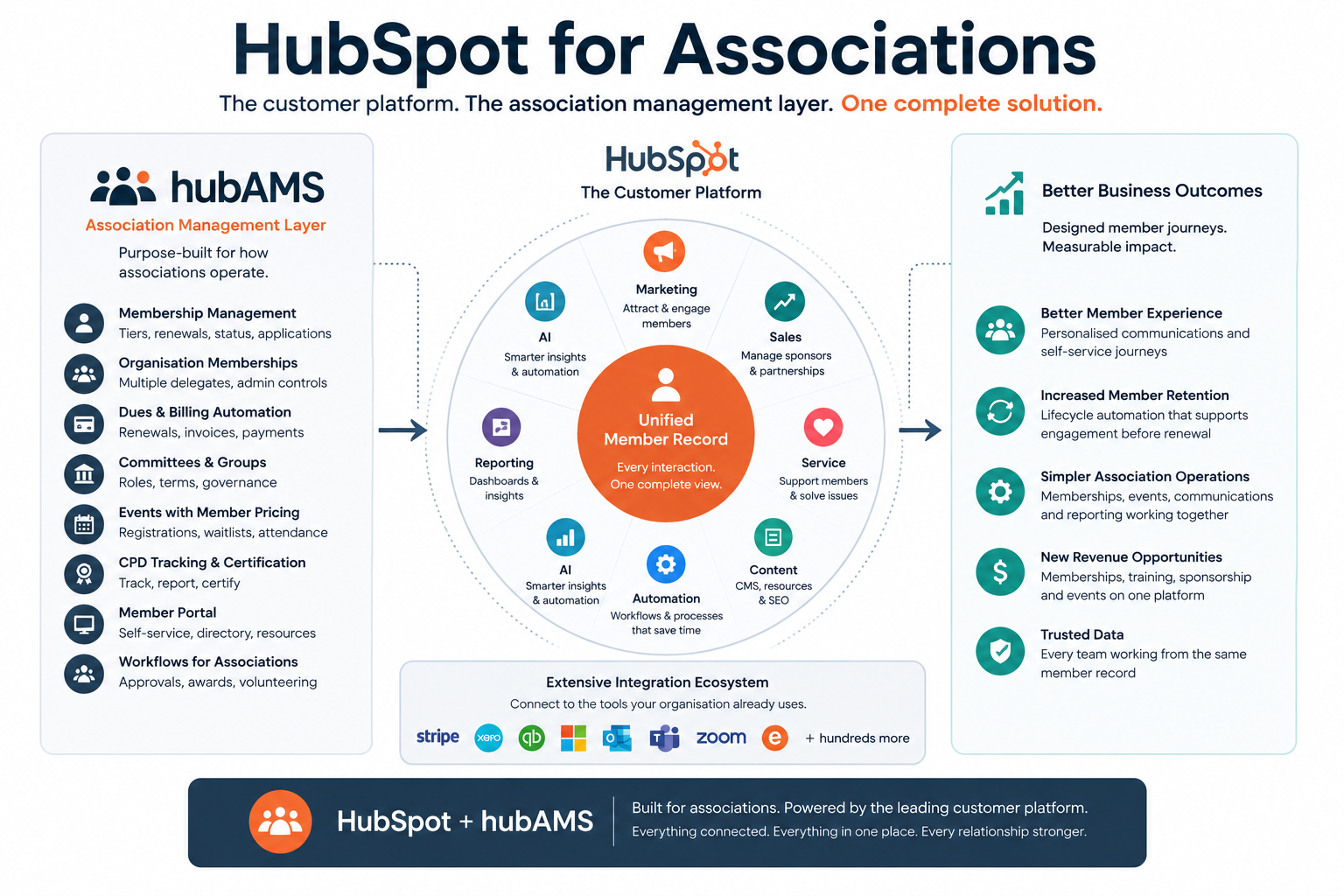
(open image in a new tab to expand view)
Why not just build this in HubSpot yourself?
It's a fair question. HubSpot is highly flexible. A developer with enough time could build custom objects, custom properties, and custom workflows to replicate much of what NativelyAMS does.
Technically? Yes.
Should you? No. Here's why.
Building association management in standard HubSpot means constructing:
- A membership data model with all the associated logic
- A renewal engine that handles grace periods, lapsed states, and billing cycles
- An organisation membership structure with delegate permissions
- A committee management system with role-based access
- A portal with association-specific functionality
- A member directory that stays in sync with the CRM
- Member dues (or subs) logic across events, training, and commerce
- CPD tracking with certification outputs
- Governance and approval workflows
Each of these is complex. Each requires development time. And each needs to be maintained indefinitely-through HubSpot platform updates, through association policy changes, through growth in membership complexity.
NativelyAMS already does all of this. It's built, tested, and deployed with migration support included. The engineering is done. The association logic is ready. And because NativelyAMS is maintained by a team whose entire focus is association management on HubSpot, the platform evolves as the sector evolves.
The custom-build path has a seductive appeal. Full control. Built exactly to spec. In practice, it creates a fragile, resource-intensive system that sits permanently on someone's to-do list.
How associations actually use HubSpot and NativelyAMS: a member's journey
Abstract benefits are useful. Seeing them in motion is more useful.
Here's how the platform works in practice, following a single member relationship from first contact to long-term engagement.
Introducing Sarah.
Sarah works in sustainability policy at a national engineering firm. She finds an industry guide on the association's website through a Google search.
She downloads the guide. A HubSpot form captures her details. A contact record is created automatically. A marketing automation sequence begins: a welcome email, a follow-up with relevant content, and a soft introduction to membership.
Three weeks later, Sarah opens the membership application. She completes it through the NativelyAMS portal. Her membership record is created, the approval workflow the association designed runs in HubSpot, and confirmation is sent when she's approved. Payment is processed via Stripe. A receipt is sent automatically.
Sarah logs into the member portal. She updates her professional profile. She registers two colleagues from her firm as delegates under the organisation's membership, all managed within the same portal without calling the office.
The following month, the annual conference registration opens. Sarah and both colleagues register. Member dues (or subs) applies automatically. Their attendance is logged to their records.
The conference includes three CPD-accredited sessions. Sarah attends all three. Her CPD total updates against the rules the association set. Her certificate is issued digitally and available in her portal.
Later in the year, the association puts out a call for committee volunteers. Sarah expresses interest. She's added to the Environment and Policy working group. Her committee role is recorded in HubSpot. She receives role-specific communications through a targeted segment.
Her organisation's membership comes up for renewal. The renewal sequence triggers six weeks out. A reminder goes to the organisation's admin contact. Sarah's firm renews online through the portal. The membership status updates instantly. No manual intervention required.
Twelve months on, the association's sponsorship team notices Sarah's employer in the CRM. A deal is created. A personalised outreach sequence begins.
Every stage of this journey, from first contact to long-term member and prospective sponsor, runs through the same platform. No integrations breaking overnight. No data living in separate systems. No staff manually updating multiple records.
One platform. One record. Every interaction strengthening the same relationship.
Why this architecture changes everything
The traditional association technology stack looks like this:
- AMS for membership records
- CRM for relationship management
- Marketing platform for email and campaigns
- Website CMS for content
- Events tool for registrations
- Payment processor for transactions
- Support tool for member queries
- Integrations to hold it all together
Each tool does its job. But the connections between them are the problem. Data syncs fail. Fields don't map correctly. Updates in one system don't reach another. Staff learn to trust certain systems for certain things and develop workarounds for everything else.
More critically: the member never exists as a single, complete picture. The marketing platform sees the email subscriber. The AMS sees the dues-paying member. The events tool sees the conference attendee. No single view holds all three.
This architecture looks different:
- HubSpot as the unified customer platform
- NativelyAMS as the association layer running inside it
- One contact record holding the complete member relationship
- All functions operating from the same data
This isn't better software bolted onto the same structure. It's a different operating model. The distinction between "platform with integrations" and "single platform" sounds subtle. In practice it changes how the organisation operates, how staff work, how data is trusted, and how member relationships are understood.
Associations don't need more integrations. They need fewer systems.
Is HubSpot and NativelyAMS right for every association?
Honestly, no. And understanding that boundary is more useful than pretending otherwise.
NativelyAMS is a strong fit for:
- Growing associations with expanding membership programs
- Professional bodies managing CPD, certification, and governance
- Trade associations with corporate memberships and delegate management
- Education providers managing training, events, and accreditation
- Organisations with multiple revenue streams: fees, events, training, sponsorship
- Associations that want to drive engagement and retention, not just administer records
- Organisations that have outgrown their current AMS and are doing too much manually
NativelyAMS is less suited to:
- Very small, volunteer-run clubs with basic administration needs and minimal budget
- Organisations with deeply customised legacy systems and no appetite for transition
- Associations that need a highly specialised vertical AMS with decades of sector-specific development (e.g., some legal or medical registration bodies)
The market for NativelyAMS is associations that want to compete on member experience and growth, not just survive on administration. If the ambition is to manage members, there are cheaper tools. If the ambition is to grow, engage, and retain them-while managing everything in one place-the platform makes a compelling case.
Frequently asked questions
Is HubSpot an Association Management System?
No. HubSpot is a customer platform providing CRM, marketing, sales, automation, service and content tools. It does not support association-specific functions such as membership tiers with entitlements, recurring dues billing, member dues (or subs), member portals or member directories. NativelyAMS is the association layer that adds these natively inside HubSpot, implemented and configured by a HubSpot Partner Agency.
What does NativelyAMS add to HubSpot for associations?
NativelyAMS provides what HubSpot doesn't have: the commerce engine behind dues, renewals and member dues (or subs), the member portal, and the member-facing templates for directories and CPD. Around that,a HubSpot Partner Agency configures HubSpot itself for association work, including membership models, committee structures, and workflows for applications, approvals and governance. All of it runs inside HubSpot rather than as an external integration.
Can HubSpot manage memberships without NativelyAMS?
Not effectively. HubSpot has no member dues (or subs) logic, no recurring dues engine and no member portal, and there's no way to build a portal in standard HubSpot because returning CRM data to a logged-in member requires purpose-built templates. A team could construct parts of a membership model using custom objects and workflows, but the missing commerce and portal layers can't be built without them.
Can members log in and self-serve with this platform?
Yes. NativelyAMS provides a member portal where members manage their own details, renew their membership, access member-only content, view invoices, register for events and track CPD. For organisation memberships, an admin contact can manage delegates and organisation-level details from the same portal. The portal is configured for each association during implementation.
Can organisations hold memberships with multiple users?
Yes. HubSpot's data model handles the relationship between an organisation and its people, and NativelyAMS makes it usable by members. An organisation admin can add or remove delegates, manage the renewal and see the organisation's registrations from within the member portal. Delegate permissions are configured for each association.
Does NativelyAMS manage renewal billing automatically?
Yes. NativelyAMS provides the recurring billing engine. The sequence around it, reminders at configurable intervals before expiry, grace period management, lapsed status and reinstatement, runs on HubSpot workflows configured by a HubSpot Partner Agency for your renewal process. Members can complete renewals online without staff involvement.
Can NativelyAMS track CPD and issue certifications?
Yes. NativelyAMS, configurated by a HubSpot Partner Agency, tracks CPD completion against member records, calculates balances relative to requirements, issues digital certificates and surfaces CPD status in the member portal. Because every CPD scheme is different, the calculation rules and logging process are built for your programme during configuration rather than shipped as a fixed template.
Can NativelyAMS run events with member dues (or subs)?
Yes.member dues (or subs) runs through NativelyAMS and applies automatically based on membership status, including tiered pricing and delegate rates for organisation members. Attendance is logged to the member record in HubSpot, and CPD credit can be assigned on completion.
Can the platform integrate with finance and accounting software?
Payments are processed through Stripe, which supports card payments, Apple Pay, Google Pay and invoice payments. Reconciliation into accounting systems runs through Stripe's own connections rather than a direct AMS-to-ledger integration, which keeps a single transaction record and avoids a second sync to maintain. Your finance team keeps working in the accounting system they already use.
Is NativelyAMS replacing HubSpot, or is it separate?
NativelyAMS is built natively inside HubSpot. It's not a replacement, a competitor or a separate platform. An association adopting NativelyAMS is running HubSpot as its platform, with NativelyAMS providing the association layer on top. The two work together as a single system, though each requires its own subscription.
Why not customise HubSpot ourselves instead of using NativelyAMS?
Parts of it can't be built at all. There's no way to construct a member portal, member pricing engine or recurring dues billing in standard HubSpot. The rest can be built, and then it has to be maintained indefinitely through platform updates, policy changes and membership growth. NativelyAMS provides the missing software already built and maintained, and a HubSpot Partner Agency provides the configuration with association experience attached.
A different model for a different era
For decades, associations have built their organisations around an AMS and connected everything else to it afterwards. The AMS held the records. Everything else, the marketing platform, the CRM, the website, the events tool, orbited around it, tethered by integrations that needed maintenance and created friction.
That model served the administration era well.
The growth era requires something different.
This turns the model on its head. Instead of starting with an AMS and bolting on growth tools, associations start with HubSpot, a platform built for engagement, marketing and relationship intelligence, and add the association layer on top.
The result is an organisation where member data drives marketing. Where renewal logic runs automatically. Where a sponsor relationship and a member relationship live on the same record. Where a board member can see membership health, event performance and revenue trajectory on one dashboard. Where staff spend their time on member experience, not on manual administration.
HubSpot provides the platform. NativelyAMS provides what HubSpot doesn't have. A HubSpot Partner Agency makes it work for associations. Together they offer something the market has rarely put on the table: a modern AMS that doesn't force a choice between operational rigour and organisational growth.
Manage less. Grow more.
If that gap has been frustrating your organisation, it's worth seeing what the platform looks like in practice. Book a demo and see your memberships, events and renewal workflows running in a single system.